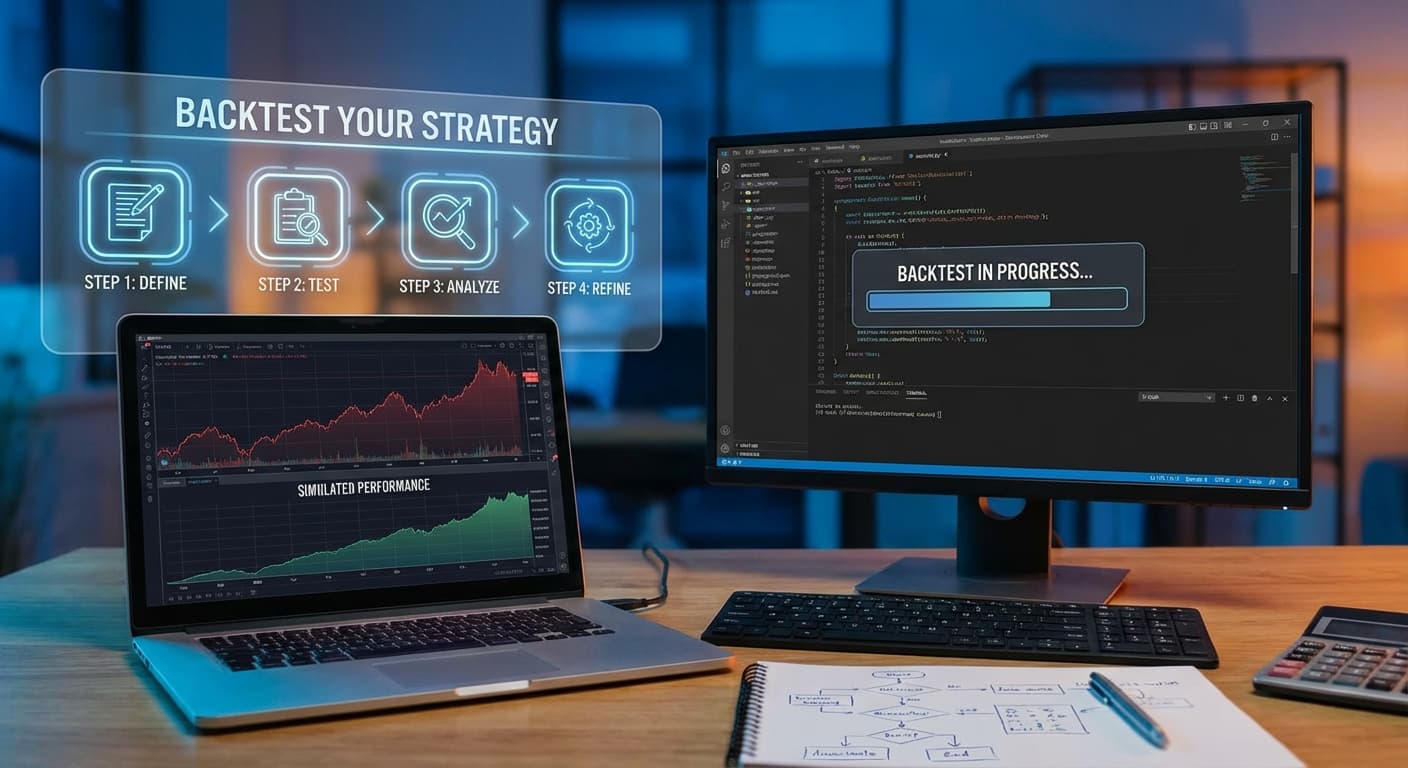
How to Backtest a Trading Strategy (Complete Step-by-Step Guide)
By HorizonAI Team
Backtesting is the process of testing a trading strategy against historical data to see how it would have performed. It's the single most important step before risking real money.
This guide walks you through how to backtest properly, avoid common pitfalls, and interpret your results.
What is Backtesting?
Backtesting simulates your trading strategy on historical price data. Instead of waiting months to see if your strategy works, you can test years of data in seconds.
A good backtest answers:
- Would this strategy have been profitable historically?
- What's the maximum drawdown I should expect?
- How often does the strategy win vs lose?
- Is the risk/reward ratio acceptable?
- Does it work across different market conditions?
Important: Past performance doesn't guarantee future results. Backtesting shows what would have happened, not what will happen. Use it to filter out bad strategies, not to predict exact future returns.
Step 1: Define Your Strategy Rules
Before you can backtest, you need clear, unambiguous rules. A backtestable strategy must answer:
Entry rules:
- What conditions trigger a buy/sell?
- Are there any filters (trend, time, volatility)?
- Do you enter at market price or limit orders?
Exit rules:
- Where is your stop loss?
- Where is your take profit?
- Do you have a time-based exit?
- Are there any trailing stop rules?
Position sizing:
- How much capital per trade?
- Fixed lot size or percentage-based?
Example strategy definition:
Entry: Go long when RSI(14) crosses above 30 AND price is above 200 EMA
Stop Loss: 1.5x ATR(14) below entry
Take Profit: 3x ATR(14) above entry (2:1 reward-to-risk)
Position Size: Risk 1% of account per trade
Pro tip: If you can't write your strategy as a set of IF-THEN rules, it's not ready for backtesting. Vague rules like "enter when it looks good" cannot be tested.
Step 2: Choose Your Backtesting Platform
Different platforms offer different capabilities:
TradingView (Pine Script)
- Best for: Quick strategy validation, visual analysis
- Data: Built-in data for stocks, forex, crypto
- Pros: Easy to use, great visualization, free tier available
- Cons: Limited to ~10,000 bars on free plan, simplified execution model
New to Pine Script? Start with our Pine Script tutorial for beginners to learn the basics. Then see our guides on how to run strategies on TradingView and backtest on TradingView.
MetaTrader 5 (MQL5)
- Best for: Forex/CFDs, detailed tick-level testing
- Data: Broker-provided data, can import external
- Pros: Tick-by-tick simulation, optimization features
- Cons: Steeper learning curve, primarily forex-focused
Learn how to set up MetaTrader 5 and use our MT5 backtesting guide for detailed instructions.
Python (Backtrader, VectorBT)
- Best for: Advanced analysis, custom data sources
- Data: Any data you can import
- Pros: Maximum flexibility, statistical analysis
- Cons: Requires programming knowledge
For most traders, TradingView is the fastest way to validate an idea. Use MT5 for forex-specific strategies or when you need tick-level precision.
Step 3: Prepare Your Data
Data quality directly impacts backtest accuracy.
Check for:
- Sufficient history: At least 2-3 years for most strategies, more for longer timeframes
- Survivorship bias: Stocks that got delisted won't appear in current data
- Data gaps: Missing bars can affect indicators and signals
- Adjusted vs unadjusted: For stocks, use split/dividend-adjusted data
Timeframe considerations:
- Higher timeframes (Daily, 4H) = fewer signals, more reliable backtest
- Lower timeframes (1m, 5m) = more signals, need tick data for accuracy
- Match your backtest timeframe to how you'll actually trade
Step 4: Set Realistic Parameters
Your backtest should simulate real trading conditions:
Starting Capital
Set a realistic account size. A $10,000 strategy behaves differently than a $1,000,000 strategy due to position sizing.
Commission and Fees
Include trading costs:
- TradingView: Settings → Properties → Commission
- MT5: Strategy Tester → Settings → specify spread and commission
Slippage
In real trading, you rarely get the exact price. Add slippage to account for this:
- Liquid markets: 0.5-1 tick
- Less liquid: 2-5 ticks
- Volatile moments: Can be much higher
Initial Bar
Skip the first bars where indicators are still calculating (e.g., skip first 200 bars if using 200 EMA).
//@version=6
strategy("My Strategy", commission_type=strategy.commission.percent, commission_value=0.1)

// Your strategy logic here
Step 5: Run the Backtest
Execute your backtest and let it process all historical data.
In TradingView:
- Add your strategy to a chart
- Open Strategy Tester tab
- Review Overview, Performance Summary, and List of Trades
In MetaTrader 5:
- Open Strategy Tester (Ctrl+R)
- Select your EA and symbol
- Set date range and model (Every Tick for accuracy)
- Click Start
Pro tip: Run the backtest multiple times across different symbols and time periods. A robust strategy should work across various conditions, not just one specific setup.
Step 6: Analyze Key Metrics
Don't just look at total profit. These metrics tell the full story. For a comprehensive breakdown of each metric, read our guide on backtesting metrics explained:
Net Profit
Total gains minus total losses. Needs context—$10,000 profit on $100,000 is different than on $10,000.
Win Rate
Percentage of winning trades. Common misconception: Higher isn't always better. A 30% win rate strategy can be very profitable with good risk/reward.
Profit Factor
Gross profit ÷ gross loss. Above 1.5 is good, above 2.0 is excellent. Below 1.0 means losing strategy.
Maximum Drawdown
Largest peak-to-trough decline. Critical for survival. A 50% drawdown requires 100% gain to recover.
Sharpe Ratio
Risk-adjusted returns. Above 1.0 is acceptable, above 2.0 is very good. Accounts for volatility of returns.
Average Trade
Net profit ÷ number of trades. Must be significantly higher than your trading costs.
Risk/Reward Ratio
- 50% win rate: Requires 1:1 R:R to break even
- 40% win rate: Requires 1.5:1 R:R to break even
- 30% win rate: Requires 2.3:1 R:R to break even
- 25% win rate: Requires 3:1 R:R to break even
Step 7: Avoid Common Backtesting Mistakes
Overfitting (Curve Fitting)
Tweaking parameters until the backtest looks perfect. The strategy memorizes past data but fails on new data.
Solution: Use out-of-sample testing. Optimize on 70% of data, test on remaining 30%.
Lookahead Bias
Using information that wouldn't be available at the time of the trade (e.g., using today's close to make a decision at today's open).
Solution: Only use data available at the moment of decision.
Survivorship Bias
Only testing stocks that exist today, ignoring those that went bankrupt or delisted.
Solution: Use point-in-time databases or acknowledge this limitation.
Ignoring Market Conditions
A strategy that works in a bull market may fail in a bear market.
Solution: Test across different market regimes (trending, ranging, high volatility, low volatility).
Unrealistic Execution
Assuming perfect fills at exact prices, no slippage, no missed trades.
Solution: Add commission, slippage, and test with conservative assumptions.
Warning: If your backtest looks too good to be true, it probably is. Real trading will always underperform a backtest due to execution realities. Learn more about common backtesting mistakes to avoid to ensure your results are reliable.
Step 8: Walk-Forward Testing
The gold standard for strategy validation:
- Divide your data into multiple segments
- Optimize on segment 1, test on segment 2
- Re-optimize on segments 1+2, test on segment 3
- Continue walking forward through all data
- Combine all out-of-sample results
This simulates how your strategy would have performed if you'd been optimizing and trading in real-time.
Step 9: Paper Trade Before Going Live
After backtesting, forward-test with paper trading:
- Trade your strategy in real-time with simulated money
- Track results for at least 20-50 trades
- Compare to backtest expectations
- Identify execution challenges (emotions, slippage, timing)
Paper trading reveals things backtesting can't: your psychological response to drawdowns, execution difficulties, and real-world market conditions.
Backtesting with HorizonAI
HorizonAI makes backtesting accessible:
- Describe your strategy in plain language
- Generate code for TradingView or MT5
- Copy to platform and run backtest
- Iterate: "The drawdown is too high—add a trailing stop" or "Only trade during London session"
- Optimize: "What if we use RSI 10 instead of 14?"
Example prompts:
- "Create an EMA crossover strategy with 2:1 risk-reward and backtest it"
- "Build a mean reversion strategy that only trades when VIX is above 20"
- "Add position sizing that risks 1% per trade to my strategy"
Learn how to write effective prompts to get better results, or check out our getting started guide.
Try it free →Backtest Checklist
Before trusting your backtest results:
- [ ] Strategy rules are 100% objective and clear
- [ ] Used realistic commission and slippage
- [ ] Tested across multiple years of data
- [ ] Tested across different market conditions
- [ ] Performed out-of-sample or walk-forward testing
- [ ] Maximum drawdown is acceptable for your risk tolerance
- [ ] Profit factor is above 1.5
- [ ] Average trade exceeds trading costs significantly
- [ ] No lookahead or survivorship bias
- [ ] Paper traded before going live
FAQs
How much historical data do I need?
Minimum 2-3 years for swing trading strategies, 5+ years for position trading. For day trading, 6-12 months can work if you have enough trades (100+ minimum).
My backtest is profitable but real trading loses money. Why?
Common causes: overfitting, execution differences (slippage, missed fills), emotional deviations from the plan, or market conditions changed. Paper trade longer and add more realistic assumptions to your backtest.
What's a good win rate?
It depends on your risk/reward ratio. A 30% win rate with 3:1 R:R is profitable. A 70% win rate with 0.3:1 R:R loses money. Focus on expectancy, not win rate alone.
Should I optimize my strategy parameters?
Carefully. Optimization can improve performance but also leads to overfitting. Always test optimized parameters on out-of-sample data. If performance drops significantly, you've overfit.
How do I know if my strategy is overfitted?
Signs: extremely high win rate, suspiciously smooth equity curve, performance drops dramatically on out-of-sample data, strategy uses many parameters that were optimized.
Summary
Proper backtesting is a process:
- Define clear, objective strategy rules
- Choose an appropriate platform (TradingView, MT5, Python)
- Prepare quality data with sufficient history
- Set realistic parameters (commission, slippage, capital)
- Run the backtest across multiple conditions
- Analyze key metrics beyond just profit
- Avoid overfitting, lookahead bias, and other pitfalls
- Validate with walk-forward testing
- Paper trade before risking real capital
Backtesting doesn't predict the future—it filters out strategies that wouldn't have worked in the past. That alone makes it invaluable.
Related Articles
Continue your backtesting education with these guides:
- Backtesting Metrics Explained — Understand win rate, profit factor, Sharpe ratio, and more
- Common Backtesting Mistakes to Avoid — Don't fall into these traps
- Backtesting Smart Money Concepts — Validate SMC strategies systematically
- Pine Script Tutorial for Beginners — Code your first strategy
- Best Pine Script Strategies — Study proven strategies
- Trend Following Strategy Guide — Backtest-ready trend systems
- Mean Reversion Trading Strategies — Counter-trend approaches
Platform guides:
- Run Strategies on TradingView — Deploy your Pine Script
- Backtest on TradingView — Step-by-step TradingView guide
- MT5 Backtesting — MetaTrader 5 testing guide
- Getting Started with HorizonAI — Generate strategies with AI
Have questions about backtesting? Join our Discord to discuss with other traders!